Working in Korea

What you need to work in Korea under the Employment Permit System — visa, pay, severance, insurance

Thumbnail — apartment towers with “Korea property tax · 16–30/9 · land in full and the second half of housing tax” over it

Working in Korea

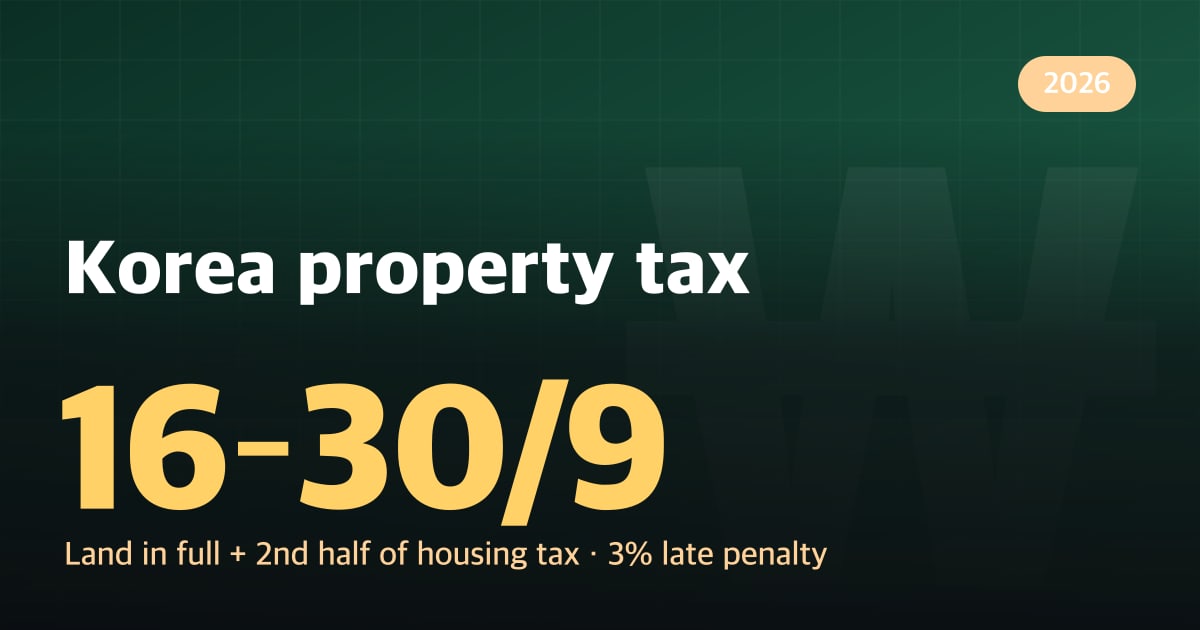
Korea property tax 9/2026: pay 16–30/9, cards, penalties

Korea's 9/2026 property tax is paid by owners of land and housing as of 1/6, from 16/9/2026 through 30/9/2026. The 9/2026 bill carries the full land portion plus the remaining half of the housing portion after the half paid in 7/2026, and the 2026 deadline is 30/9/2026 (Wed). You can look up and pay property tax nationwide on Wetax and the Smart Wetax app; Seoul also takes Seoul ETAX, the STAX app and mobile payment apps. Past the deadline a 3% late payment penalty tax is added, and if the tax per bill and per tax item is 450,000 won or more an extra 0.66% is added every month. If the tax exceeds 2,500,000 won, you can apply by 30/9 to split part of it over 3 months.
Thumbnail — “Chuseok 2026 holidays” on a dark red background, “24–27/9” in large yellow letters, and “28/9 temporary holiday: not designated as of 15/9 · no substitute holiday” below

Working in Korea

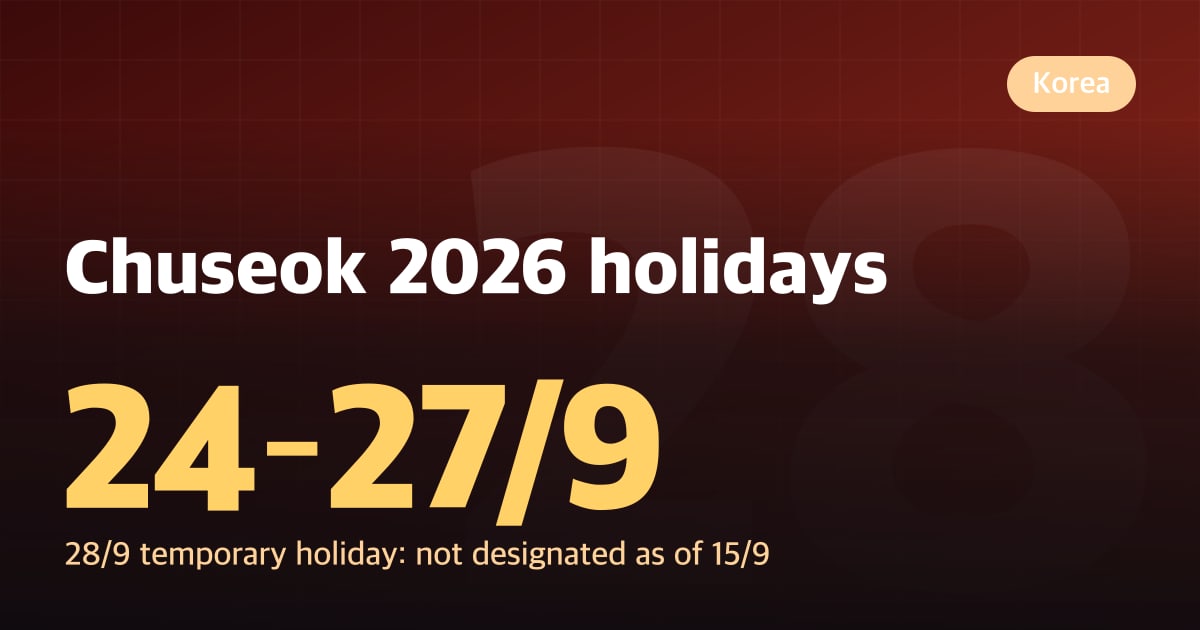
Chuseok 2026 Holidays in Korea: 28/9 Temporary Holiday, No Substitute Day, 10/2026 Holidays

The 2026 Chuseok (Korean Thanksgiving) holiday runs 4 days from Thursday 24/9 to Sunday 27/9/2026. As of 15/9, 28/9 (Monday) is a regular weekday not designated a temporary public holiday, with no designation in the Ministry of Personnel Management press release or in the agenda of the September Cabinet meetings either. The last day of the Chuseok holiday, 26/9, falls on a Saturday, but Seollal (Lunar New Year) and Chuseok do not generate a substitute holiday even when they overlap a Saturday. If 28/9 is designated a temporary public holiday, the holiday becomes 5 days long and is a paid holiday at workplaces with 5 or more regular employees. The public holidays after Chuseok are National Foundation Day on 3/10, the substitute holiday on 5/10, Hangeul Day on 9/10, and Christmas Day on 25/12.

Thumbnail — dark purple background with “2027 rates for the 4 social insurances” in Korean, below it in large yellow letters “Pension 10% · Health insurance 7.19%”, and at the bottom “₩299,021 deducted from a ₩3 million monthly wage”

Working in Korea

Korea 2027 Rates for the 4 Social Insurances: Pension 10%, Health Insurance 7.19% Frozen, Deductions on a ₩3 Million Wage

For 2027, the National Pension premium rate is 10.0% and the National Health Insurance premium rate is frozen at 7.19%. The worker's share is 5.0% for the National Pension, 3.595% for health insurance and 0.9% for employment insurance, while industrial accident compensation insurance is paid entirely by the employer. On a monthly wage of ₩3 million, ₩299,021 goes out as the 4 social insurances — ₩7,500 more than in 2026, all of it from the National Pension. The long-term care insurance rate and the employment insurance reform plan are not decided yet. This article lays out the rate table and the deduction calculations.

Thumbnail - dark green background with the text 'EITC Payment Date and Amount,' below it in large yellow letters 'Up to ₩3.3 Million,' and at the bottom 'Payment 17 December · Eligibility · 2027 reform bill'

Working in Korea

Korea EITC 2026 (근로장려금): First-Half Payment Date 17 December, Up to ₩3.3 Million, Eligibility and How to Apply

The first-half EITC applied for in September 2026 will be paid on 17 December. The amount is 35% of the annual amount, up to ₩1.15 million. On an annual basis, the maximum is ₩1.65 million for a single household, ₩2.85 million for a single-earner household, and ₩3.3 million for a dual-earner household, with combined spousal gross income and household assets under ₩240 million as the criteria. The next applications are March 2027 (second-half portion) and May (regular portion). The government's tax reform bill includes a plan to raise the maximum to ₩3.6 million from 2027, but the National Assembly vote is still pending. This guide covers eligibility, how to apply, and the reduction criteria.

Thumbnail — on a deep indigo background, “2027 Unemployment Benefit Daily Minimum” with “₩68,480” below in large yellow type, and at the very bottom “6-Day Payment Reform Plan · ₩1.76 Million Monthly · Eligibility Guide”; “Per Day” in the top right

Working in Korea

Korea Unemployment Benefits 2027: ₩68,480 Daily Minimum, 6-Day Payment Reform, Monthly Amount and Eligibility

For people leaving their job in 2027, the unemployment benefit daily minimum is ₩68,480 per day (based on the 2027 minimum wage). On 1 September 2026 the government deliberated a reform plan to pay unemployment benefits on a 6-day-per-week basis instead of 7 days per week. The total amount and the number of days (120–270 days) stay the same, but the monthly amount drops to ₩1.76 million for daily-minimum recipients, while the receiving period gets longer. The daily maximum will be tied to 103% of the daily minimum, and the unemployment-benefit premium rate rises from 1.8% to 2.0%. The 6-day payment requires an amendment to the law and has not yet taken effect. This article covers the eligibility conditions, benefit days, and calculation method.

Thumbnail — dark navy background with "2027 minimum hourly wage", below it in large yellow letters "₩10,700", at the bottom "monthly pay ₩2,236,300 · part-time monthly pay table · weekly holiday pay", top right "3.7% ↑"

Working in Korea

Korea Minimum Wage 2027: ₩10,700 an Hour, ₩2,236,300 a Month - Part-Time Pay Table and Weekly Holiday Pay

From 1 January 2027, the minimum wage is ₩10,700 per hour. It is up ₩380 (3.7%) from ₩10,320 in 2026, and working 40 hours a week gives a monthly pay of ₩2,236,300 (before tax) including weekly holiday pay (주휴수당). The daily pay is ₩85,600, and the annual pay equivalent is ₩26,835,600. The same amount applies regardless of industry, workplace size or nationality. This guide also includes a part-time job monthly pay table for 15 to 35 hours a week and how to calculate weekly holiday pay and probation reductions.

Illustration of a passport, a work permit card and a calendar seen from above

Working in Korea

The E-9 Visa: What It Permits, How Long You Can Stay, and When You May Change Employer

Non-professional employment (비전문취업) E-9 is defined by exclusion — item 21 of attached Table 1-2 to the Enforcement Decree of the Immigration Act (출입국관리법 시행령 [별표 1의2]) covers anyone meeting the domestic employment requirements under the Act on the Employment of Foreign Workers (외국인근로자의 고용 등에 관한 법률), except those going into professional occupations. Employment activity runs 3 years from entry, extendable only once by less than 2 years — administered as 1 year 10 months, making 4 years 10 months — and one re-entry under the committed-worker re-entry special provision (성실근로자 재입국 취업 특례) takes the ceiling to 9 years 8 months. Changing workplace needs immigration's permission on statutory grounds, with an application required within 1 month of the contract ending and permission required within 3 months of filing. There is no dependent visa.

Illustration of an empty examination-room desk and answer sheet

Working in Korea

EPS-TOPIK Passing Scores and Selection — Why You Can Fail Even with More Than 60 Points

EPS-TOPIK is a Korean-language test administered by HRD Korea (한국산업인력공단) since August 2005 to rank candidates for the foreign jobseeker roster (외국인구직자 명부). It is different from the TOPIK administered by the National Institute for International Education (국립국제교육원), and it does not award proficiency levels. The exam has 40 questions worth 100 points and lasts 50 minutes, using CBT or UBT. The minimum scores are 60 for manufacturing, 45 for other sectors, and 30 Pass/Fail for the special fisheries track (어업특례). But clearing the minimum does not mean you have passed. The assessment is norm-referenced, and you must also take the second-stage skills test and job-capacity assessment (기능시험 및 직무능력평가).

Diagram showing how 209 monthly hours are built from 40 contracted hours plus 8 paid weekly-holiday hours

Working in Korea

Korea's 2026 Minimum Wage: ₩10,320 an Hour, ₩2,156,880 a Month

The minimum wage in Korea is ₩10,320 an hour from 1 January to 31 December 2026. The government's own monthly equivalent is ₩2,156,880 — gross, before deductions, built on 209 hours. It applies to every workplace with no exemption for industry or size, and to an E-9 worker on the same terms as anyone else. Below: where 209 comes from, what legally comes off your pay, and what your payslip has to show you.

Diagram comparing departure guarantee insurance at 8.3% of the monthly ordinary wage on the Employment Permit with statutory severance of 30 days' average wage per year, and the employer's duty to pay the difference

Working in Korea

Insurance for E-9 Workers: Who Pays What, and Why Departure Guarantee Insurance Is Not Your Severance

Industrial-accident insurance is funded entirely by the employer, so a line for it in your deductions is unlawful. Employment insurance has been mandatory for E-9 workers since the phase-in completed, and still deducts nothing unless you have opted into unemployment benefit at 0.9%. The National Pension is deducted for workers from the Philippines, China, Vietnam and Indonesia among others, and not at all for workers from Nepal, Myanmar, Bangladesh, Pakistan and Timor-Leste — but the E-9 visa is itself a qualifying route for the lump-sum refund, so nationality decides enrolment, not the refund. And departure guarantee insurance, at 8.3% of the ordinary wage on your Employment Permit, is a floor under your severance rather than the whole of it: where the lump sum falls short, the employer owes the difference.

Diagram of the official MOEL severance formula: daily average wage x 30 days x (days employed / 365)

Working in Korea

Severance Pay in Korea (퇴직금): How Much You Get and When It Must Be Paid

Work one year or more at the same workplace in Korea, with scheduled hours averaging 15 or more a week, and you are owed statutory severance pay: at least 30 days' average wage for every year of continuous service. The worked example below puts the 2026 monthly minimum wage of ₩2,156,880 through the Ministry of Employment and Labor formula and returns a figure near ₩2.1 million for one year. Nationality is not one of the conditions. The money is due within 14 days of your retirement date, and you have three years to claim it.