Korea Guide

A local guide to Korea for international visitors, based on real visits

Latest posts

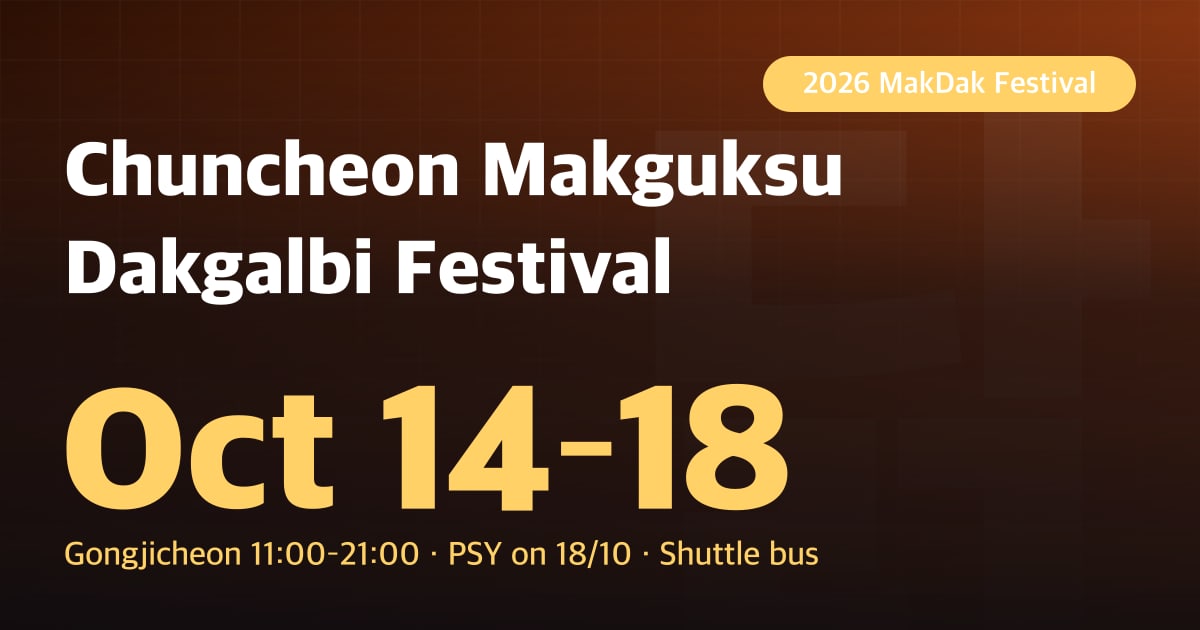
Thumbnail — orange background with the text “Chuncheon Makguksu Dakgalbi Festival”, “Oct 14–18”, “Gongjicheon 11:00–21:00 · PSY on 18/10 · Shuttle bus” and “2026 MakDak Festival”

Travel Tips

Chuncheon Makguksu Dakgalbi Festival 2026 (MakDak Festival): 14–18/10 at Gongjicheon, PSY & Lineup, Shuttle Bus, Prices, Coupons

The Chuncheon Makguksu Dakgalbi Festival (춘천막국수닭갈비축제), MakDak Festival (막닭축제) for short, runs for five days from Wednesday 14/10/2026 to Sunday 18/10/2026 along the Gongjicheon Stream walking path (586 Onui-dong, Chuncheon). It is open every day from 11:00 to 21:00, and on the last day, 18/10, PSY takes the Waterside Stage at 8:20 pm. At the festival, dakgalbi costs 9,900 won per serving and makguksu 6,900 won (as reported by Balpum News on 30/9). Outside the festival grounds, partner restaurants take 3,000 won off dakgalbi and 1,500 won off makguksu with discount coupons until 25/10.
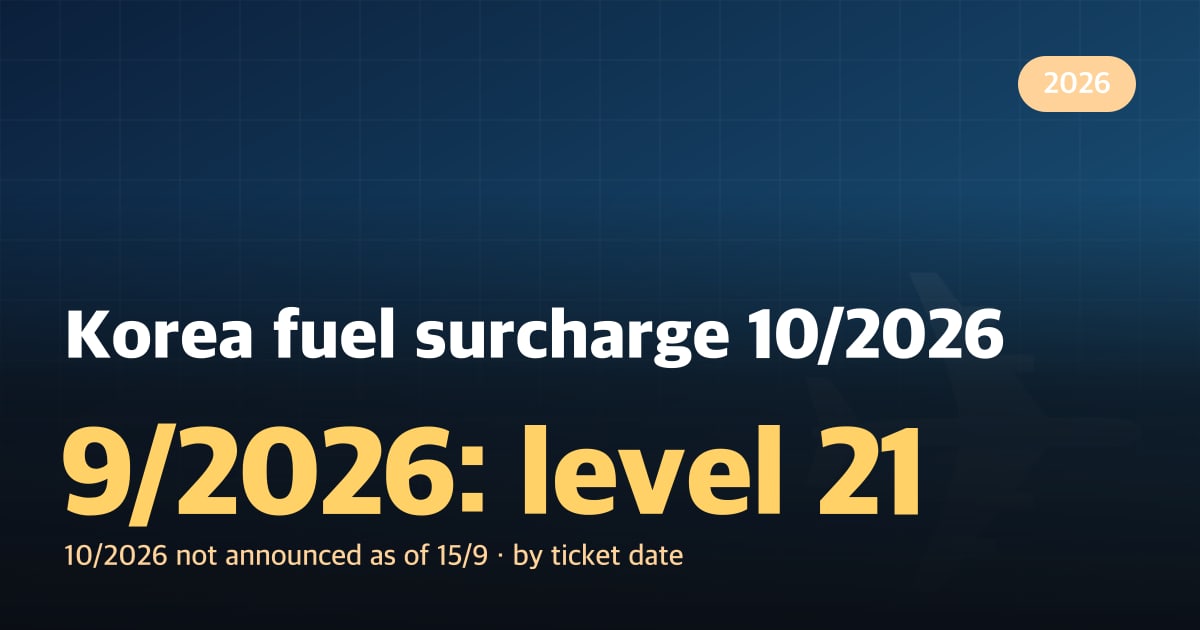
Thumbnail — an airliner wing at sunset with “Korea fuel surcharge 10/2026 · 9/2026: level 21” over it

Travel Tips

Korea fuel surcharge 10/2026 — Korean Air, Asiana 9/2026 level 21; domestic 20,900~22,000 won

As of 15/9, the 10/2026 international fuel surcharge has not yet been announced by the airlines. The 10/2026 amount is set from the average Singapore jet fuel price between 16/8 and 15/9. The 9/2026 amount now in effect is level 21 per Asiana Airlines' notice, with one-way surcharges departing Korea at 48,000~354,000 won on Korean Air and 52,000~290,100 won on Asiana Airlines. The fuel surcharge is based on the ticket issue date, not the travel date, so tickets issued through 30/9 carry the 9/2026 amount. The 10/2026 domestic surcharge is already announced: 20,900 won one way on Korean Air, Asiana Airlines and Trinity Airways, and 22,000 won on Jeju Air, Jin Air and Eastar Jet.

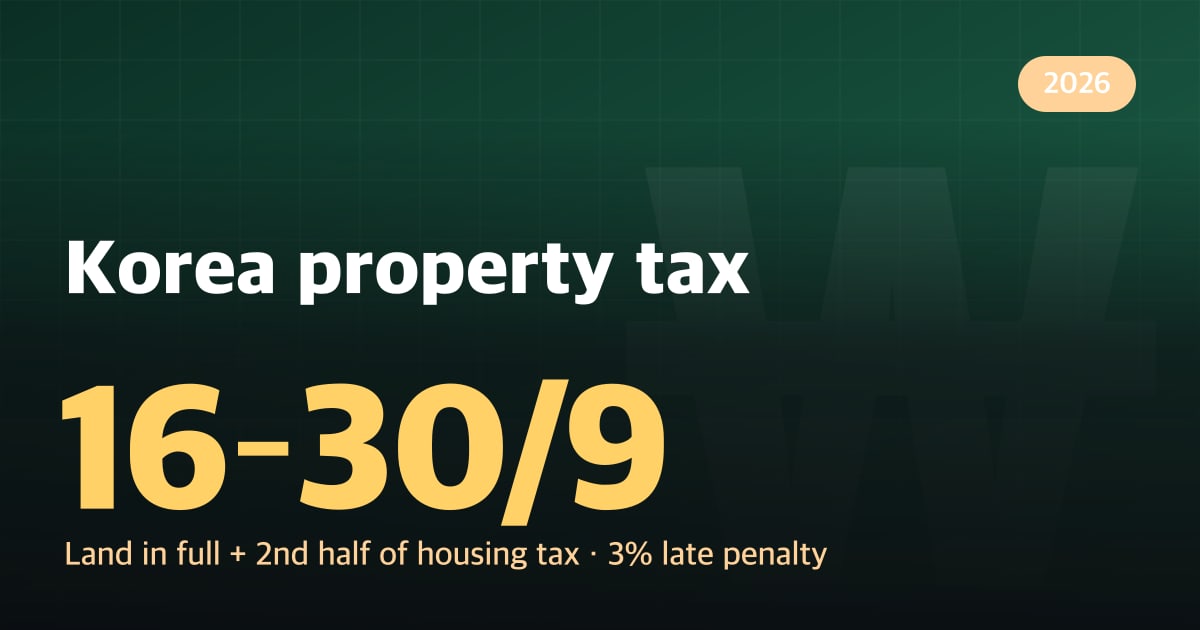
Thumbnail — apartment towers with “Korea property tax · 16–30/9 · land in full and the second half of housing tax” over it

Working in Korea

Korea property tax 9/2026: pay 16–30/9, cards, penalties

Korea's 9/2026 property tax is paid by owners of land and housing as of 1/6, from 16/9/2026 through 30/9/2026. The 9/2026 bill carries the full land portion plus the remaining half of the housing portion after the half paid in 7/2026, and the 2026 deadline is 30/9/2026 (Wed). You can look up and pay property tax nationwide on Wetax and the Smart Wetax app; Seoul also takes Seoul ETAX, the STAX app and mobile payment apps. Past the deadline a 3% late payment penalty tax is added, and if the tax per bill and per tax item is 450,000 won or more an extra 0.66% is added every month. If the tax exceeds 2,500,000 won, you can apply by 30/9 to split part of it over 3 months.

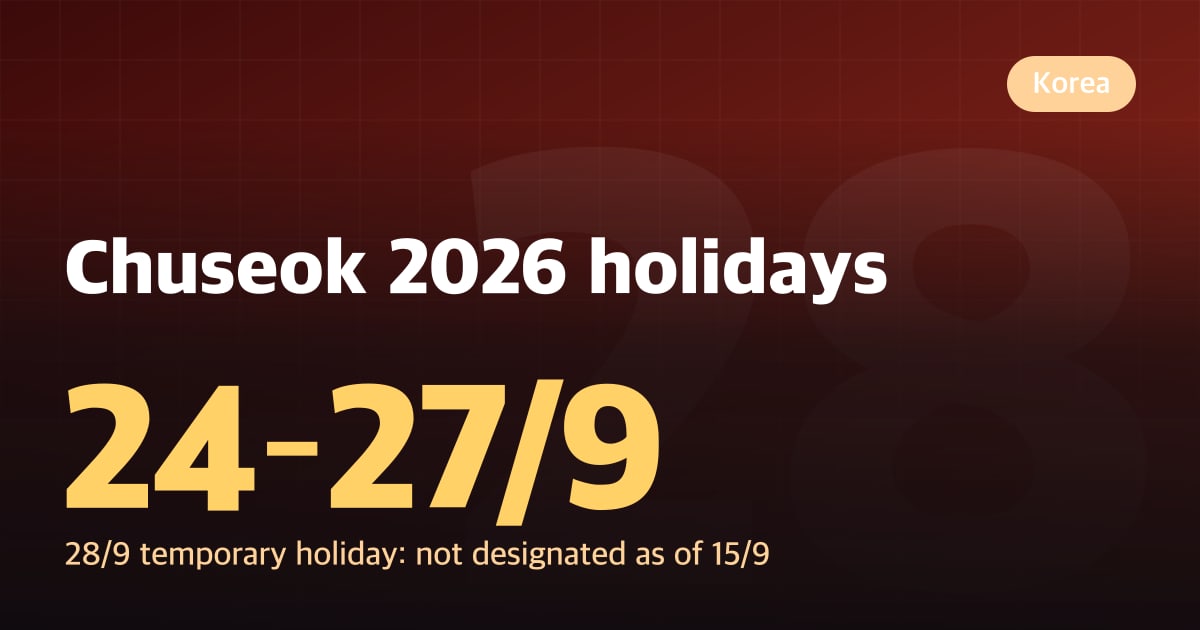
Thumbnail — “Chuseok 2026 holidays” on a dark red background, “24–27/9” in large yellow letters, and “28/9 temporary holiday: not designated as of 15/9 · no substitute holiday” below

Working in Korea

Chuseok 2026 Holidays in Korea: 28/9 Temporary Holiday, No Substitute Day, 10/2026 Holidays

The 2026 Chuseok (Korean Thanksgiving) holiday runs 4 days from Thursday 24/9 to Sunday 27/9/2026. As of 15/9, 28/9 (Monday) is a regular weekday not designated a temporary public holiday, with no designation in the Ministry of Personnel Management press release or in the agenda of the September Cabinet meetings either. The last day of the Chuseok holiday, 26/9, falls on a Saturday, but Seollal (Lunar New Year) and Chuseok do not generate a substitute holiday even when they overlap a Saturday. If 28/9 is designated a temporary public holiday, the holiday becomes 5 days long and is a paid holiday at workplaces with 5 or more regular employees. The public holidays after Chuseok are National Foundation Day on 3/10, the substitute holiday on 5/10, Hangeul Day on 9/10, and Christmas Day on 25/12.

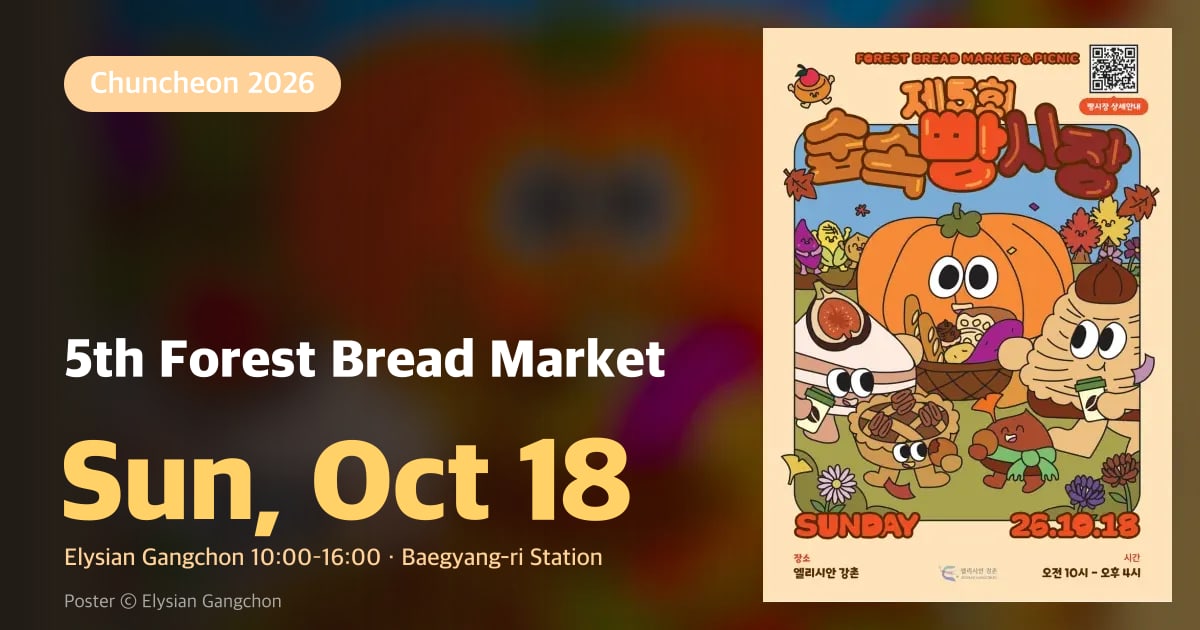
Thumbnail — the Forest Bread Market poster next to the text “5th Forest Bread Market”, “Sun, Oct 18” (18/10/2026) and “Elysian Gangchon 10:00–16:00 · Baegyang-ri Station”

Travel Tips

5th Forest Bread Market 2026 at Elysian Gangchon: 18/10, Tickets, Shuttle Bus

Forest Bread Market (숲속빵시장) is a bread and dessert festival that Elysian Gangchon in Chuncheon holds in spring and autumn. The 5th edition runs for one day only, on Sunday 18/10/2026 from 10:00~16:00, around the Elysian Gangchon Camping Park. As of 14/9/2026, the admission fee and advance booking schedule for the 5th edition have not yet been announced. At the 4th edition last May, online advance tickets cost 5,000 won for adults and on-site purchase cost 10,000 won for adults, and visitors who arrived by suburban train and got off at Baegyang-ri Station entered free. The 4th edition drew 25,000 people in one day, and most products sold out around 2 PM. If you get off at Baegyang-ri Station on the Gyeongchun Line (subway), you can enter the resort on the free Elysian Gangchon loop shuttle bus.

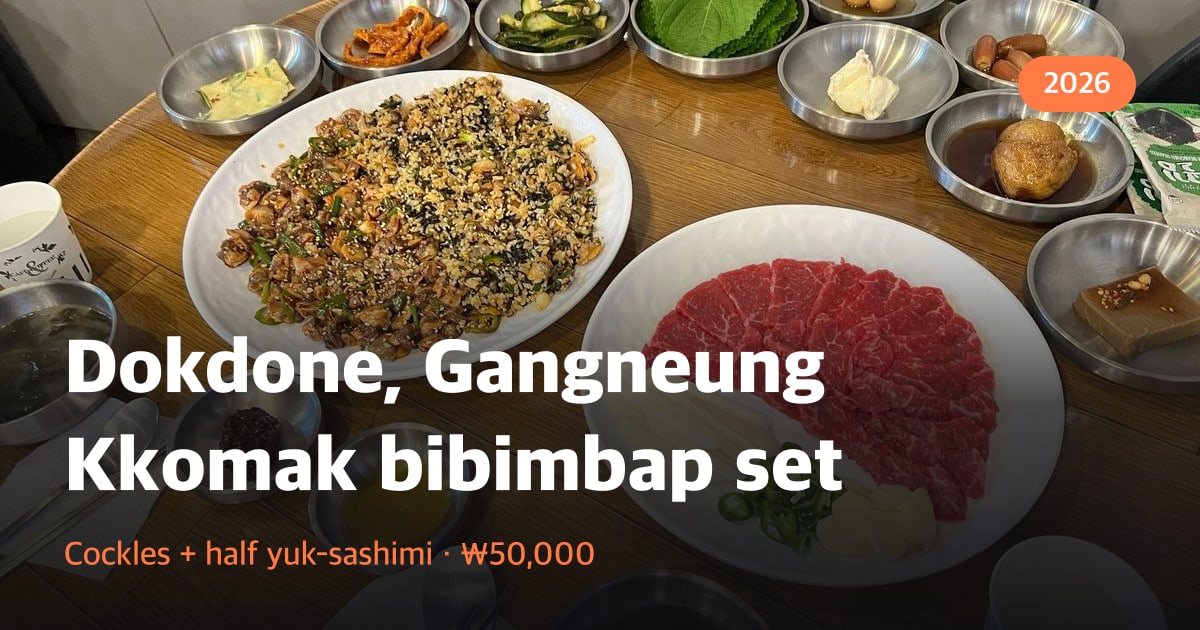
Thumbnail — a photo of a table set with one plate of kkomak bibimbap, a plate of yuk-sashimi 1/2, and side dish bowls, with "Dokdone Gangneung kkomak bibimbap set" over it and "Kkomak muchim + yuk-sashimi 1/2 · 50,000 won" below

Food

Dokdone Gangneung Kkomak Bibimbap & Yuk-sashimi 2026: Menu Prices, 50,000 Won Set for 2, How to Eat, Waiting, Parking

Dokdone main branch (강릉꼬막집 독도네 본점) is a Gangneung restaurant selling kkomak muchim, yuk-sashimi, and yukhoe muchim right in front of Dongbu Market in Gangneung. As of the main branch menu board on September 12, 2026, kkomak muchim is 37,000 won for the Couple and 58,000 won for the Large, bibimbap included, and the kkomak muchim + yuk-sashimi 1/2 set, which the restaurant writes is its best-selling menu, is 50,000 won. When the 2 of us ate this set, the portion was generous, and we were recommended to eat the kkomak bibimbap without mixing it, wrapping kkomak bibimbap, kkomak, and oi muchim in a perilla leaf. Hours are 12:00~21:40 (last order 20:40), and it closes every Tuesday. You join the waiting list at the restaurant by writing down your phone number, and takeout is available. There is no parking lot of its own.

Thumbnail — dark navy background with the text "When does the K-ETA waiver end", below it "2026.12.31." in large yellow letters, and at the bottom "2027 extension not announced · Fee ₩10,000 · Valid for 3 years"

Travel Tips

K-ETA 2027: Waiver Runs Until 31 December 2026 - How to Apply, ₩10,000 Fee, 3-Year Validity

The K-ETA temporary waiver operated by the Ministry of Justice runs until 31 December 2026. Whether it will be extended to 2027 was not announced as of 12 September 2026. K-ETA is an electronic travel authorization that foreign nationals entering Korea visa-free must obtain before boarding. The fee is ₩10,000 per person (about US$7-8), plus a payment fee of about 3%, and it is non-refundable. Review usually takes within 72 hours, and the authorization is valid for 3 years. This guide covers who is exempt, how to apply, and periods of stay.

Thumbnail — dark purple background with “2027 rates for the 4 social insurances” in Korean, below it in large yellow letters “Pension 10% · Health insurance 7.19%”, and at the bottom “₩299,021 deducted from a ₩3 million monthly wage”

Working in Korea

Korea 2027 Rates for the 4 Social Insurances: Pension 10%, Health Insurance 7.19% Frozen, Deductions on a ₩3 Million Wage

For 2027, the National Pension premium rate is 10.0% and the National Health Insurance premium rate is frozen at 7.19%. The worker's share is 5.0% for the National Pension, 3.595% for health insurance and 0.9% for employment insurance, while industrial accident compensation insurance is paid entirely by the employer. On a monthly wage of ₩3 million, ₩299,021 goes out as the 4 social insurances — ₩7,500 more than in 2026, all of it from the National Pension. The long-term care insurance rate and the employment insurance reform plan are not decided yet. This article lays out the rate table and the deduction calculations.

Thumbnail - dark green background with the text 'EITC Payment Date and Amount,' below it in large yellow letters 'Up to ₩3.3 Million,' and at the bottom 'Payment 17 December · Eligibility · 2027 reform bill'

Working in Korea

Korea EITC 2026 (근로장려금): First-Half Payment Date 17 December, Up to ₩3.3 Million, Eligibility and How to Apply

The first-half EITC applied for in September 2026 will be paid on 17 December. The amount is 35% of the annual amount, up to ₩1.15 million. On an annual basis, the maximum is ₩1.65 million for a single household, ₩2.85 million for a single-earner household, and ₩3.3 million for a dual-earner household, with combined spousal gross income and household assets under ₩240 million as the criteria. The next applications are March 2027 (second-half portion) and May (regular portion). The government's tax reform bill includes a plan to raise the maximum to ₩3.6 million from 2027, but the National Assembly vote is still pending. This guide covers eligibility, how to apply, and the reduction criteria.

Thumbnail — on a deep indigo background, “2027 Unemployment Benefit Daily Minimum” with “₩68,480” below in large yellow type, and at the very bottom “6-Day Payment Reform Plan · ₩1.76 Million Monthly · Eligibility Guide”; “Per Day” in the top right

Working in Korea

Korea Unemployment Benefits 2027: ₩68,480 Daily Minimum, 6-Day Payment Reform, Monthly Amount and Eligibility

For people leaving their job in 2027, the unemployment benefit daily minimum is ₩68,480 per day (based on the 2027 minimum wage). On 1 September 2026 the government deliberated a reform plan to pay unemployment benefits on a 6-day-per-week basis instead of 7 days per week. The total amount and the number of days (120–270 days) stay the same, but the monthly amount drops to ₩1.76 million for daily-minimum recipients, while the receiving period gets longer. The daily maximum will be tied to 103% of the daily minimum, and the unemployment-benefit premium rate rises from 1.8% to 2.0%. The 6-day payment requires an amendment to the law and has not yet taken effect. This article covers the eligibility conditions, benefit days, and calculation method.

Thumbnail — dark navy background with "2027 minimum hourly wage", below it in large yellow letters "₩10,700", at the bottom "monthly pay ₩2,236,300 · part-time monthly pay table · weekly holiday pay", top right "3.7% ↑"

Working in Korea

Korea Minimum Wage 2027: ₩10,700 an Hour, ₩2,236,300 a Month - Part-Time Pay Table and Weekly Holiday Pay

From 1 January 2027, the minimum wage is ₩10,700 per hour. It is up ₩380 (3.7%) from ₩10,320 in 2026, and working 40 hours a week gives a monthly pay of ₩2,236,300 (before tax) including weekly holiday pay (주휴수당). The daily pay is ₩85,600, and the annual pay equivalent is ₩26,835,600. The same amount applies regardless of industry, workplace size or nationality. This guide also includes a part-time job monthly pay table for 15 to 35 hours a week and how to calculate weekly holiday pay and probation reductions.

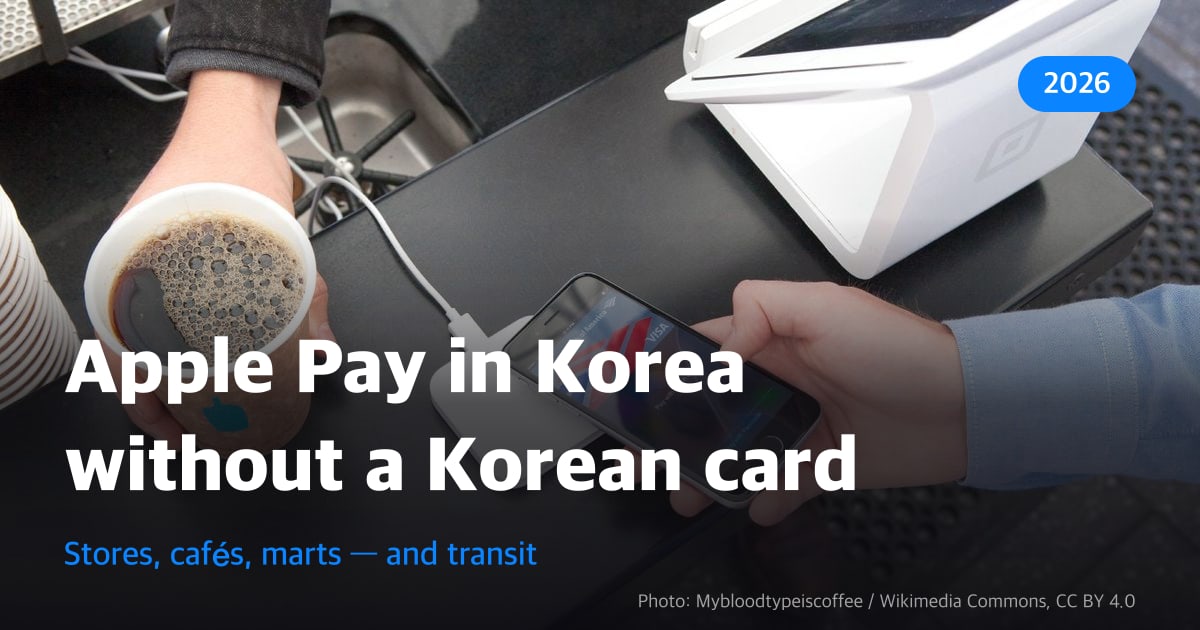
Thumbnail — a photo of an iPhone held to a contactless reader at a cafe checkout, overlaid with "Where Apple Pay works without a Hyundai Card" and below it "Convenience stores, cafes, marts, department stores"

Travel Tips

Apple Pay in Korea 2026: Where It Works Without a Hyundai Card — Convenience Stores, Cafes, Marts

The only Korean card you can add to Apple Wallet is a Hyundai Card (per Apple's official list, posted 7 August 2026). But if you brought a card issued overseas and added it to Apple Wallet, it pays at the very same terminals — convenience stores like GS25 and CU, Starbucks and Mega MGC Coffee, Daiso, Olive Young and Homeplus marts, Lotte Department Store and duty-free shops all accept Apple Pay. You cannot ride the subway or buses with a credit card in Apple Pay; a prepaid T-money card is needed separately. This guide sorts out which checkout counters work and which kiosks do not, brand by brand.

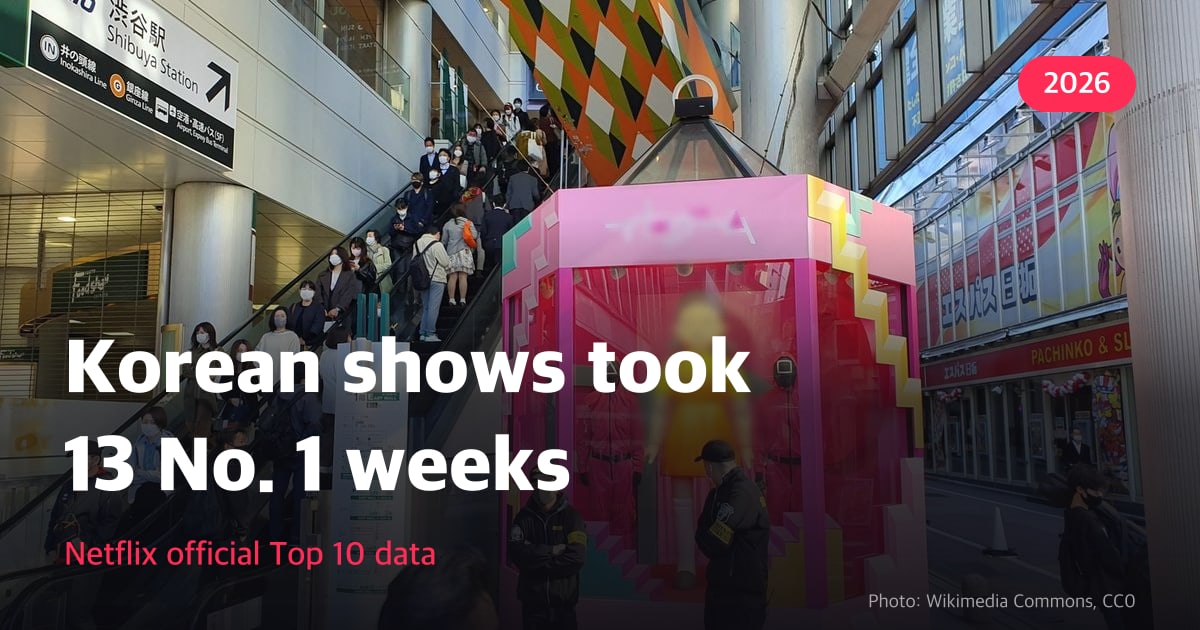
Thumbnail: “Korean shows took 13 No. 1 weeks” over a photo of a Squid Game promotional booth in Shibuya, Tokyo, with “Netflix official Top 10 data” underneath

Hallyu

Best Korean Shows to Watch in 2026: 8 Netflix Picks With Plot and Cast, Plus Disney+

Looking for a Korean show to watch. Here are eight titles with their plot and cast: the ones that charted on Netflix in 2026 plus Squid Game, the all-time leader, along with Made in Korea and Moving on Disney+.

Thumbnail: “How K-pop shows pick their No. 1” over a photo of Shinyu of TWS, with “All 6 shows: charts, apps, air times” underneath

Hallyu

K-pop Music Shows 2026: How Music Bank, Inkigayo, Show! Music Core, M Countdown, Show Champion and The Show Pick No. 1, Plus Air Times, Voting Apps and How to Watch Abroad

A music show win combines streaming, album sales, video/SNS, broadcast and fan-vote scores under names and weights that differ by show: Music Bank weighs digital streaming at 60%, Inkigayo weighs SNS at 20%, Show Champion weighs the global fan vote at 20%. Here are the six shows' splits, air days and times, the voting apps that work from abroad and where the live streams are, as of September 2026 and as stated in the broadcasters' own notices.

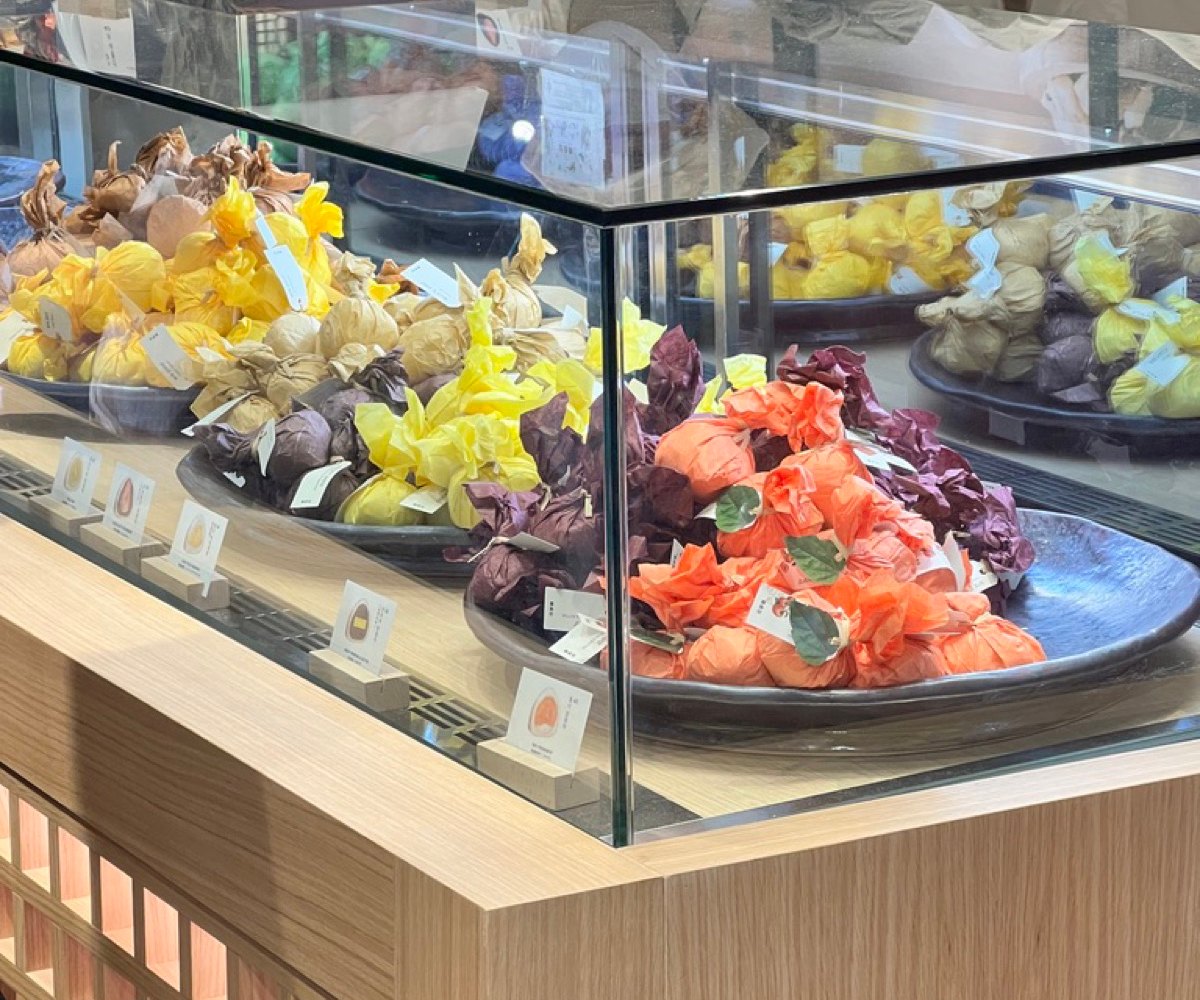
Hanjungsun display case at the Lotte World Mall store — chapssaltteok wrapped in yellow, purple, orange and brown hanji stacked by flavor on black plates (photographed in person, first week of September 2026)

Food

Hanjungsun Chapssaltteok 2026: Menu, Prices, Gift Sets from 33,000 Won and Store Hours — Seongsu to Lotte World Mall and Seoul Station, Plus the GS25 Convenience-Store Version

Hanjungsun (韓貞仙) is a Seoul dessert brand that puts fruit and yogurt inside its chapssaltteok and wraps each piece in colorful hanji paper. Starting from its Seongsu flagship, it has opened stores in the Shinsegae, Hyundai and Lotte department store food halls and at Seoul Station, and queues form outside the stores even on ordinary days. Based on the Lotte World Mall menu board in September 2026, individual pieces run 3,500–6,500 won (ang butter from 3,500 won up to Dubai chocolate at 6,500 won), the 3 new Greek yogurt items are 6,000 won, and gift sets are 33,000 won for the 6-piece set and 46,000 won for the 9-piece set. From September 3, GS25 sells a frozen yogurt chapssaltteok for 3,900 won. Store-by-store hours come from the brand's official introduction text, and the gift set packaging and foreigner discount details were compiled from visits in person.

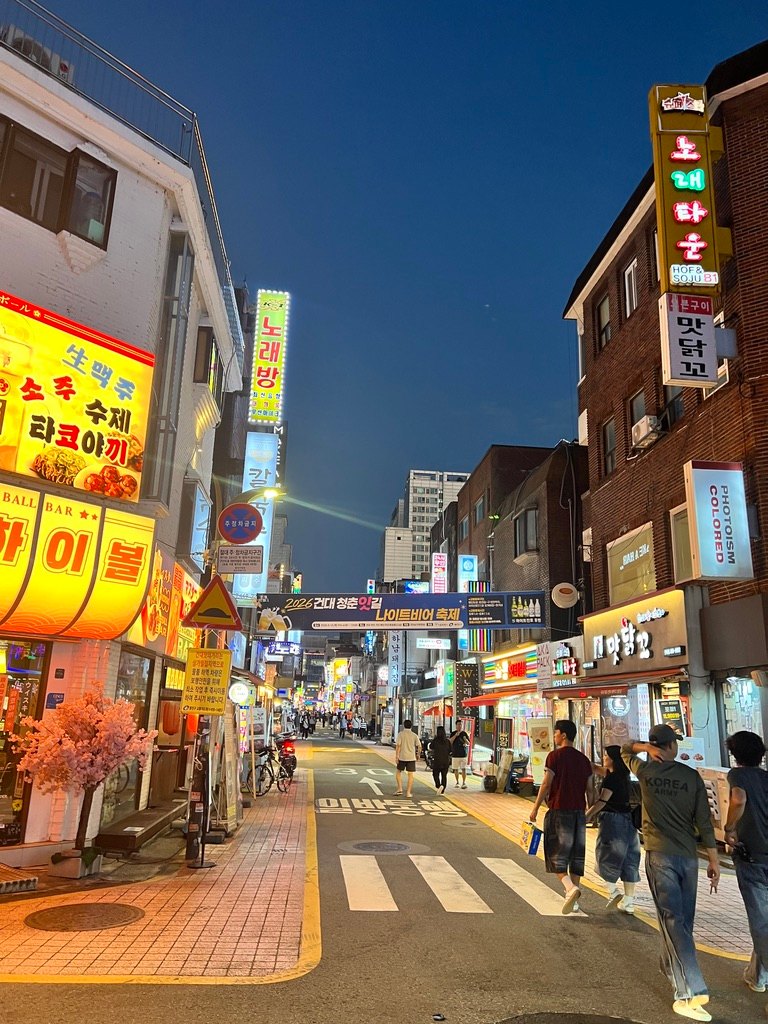
Kondae Food Street at dusk — the '2026 Kondae Cheongchun-matgil Night Beer Festival' banner, noraebang, highball-bar and chicken-skewer signs on a one-way alley (photographed in early September 2026)

Food

Kondae Food Guide 2026: 6 Best Spots — Lamb Skewer Street, Common Ground, Pyongyang Naengmyeon

Konkuk University Station (Lines 2 and 7) serves something different to eat at every exit. Exit 5 opens onto Lamb Skewer Street, where 60-odd Chinese restaurants are gathered; behind Exit 1 is Kondae Food Street (Mat-ui Geori), lined with chimaek and grilled-meat restaurants; and 196m from Exit 6 stands Common Ground, built from 200 shipping containers. Add to these Seobuk Myeonok, which has served Pyongyang naengmyeon since 1968; Songnim Sikdang, a truck driver's restaurant that opens at 6 a.m.; and the ramen shop Umaido — all of them listed in official materials from the Korea Tourism Organization, the Seoul Metropolitan Government and Gwangjin District. Each entry lists its signature dishes, and where the address and hours are confirmed, a map link as well.

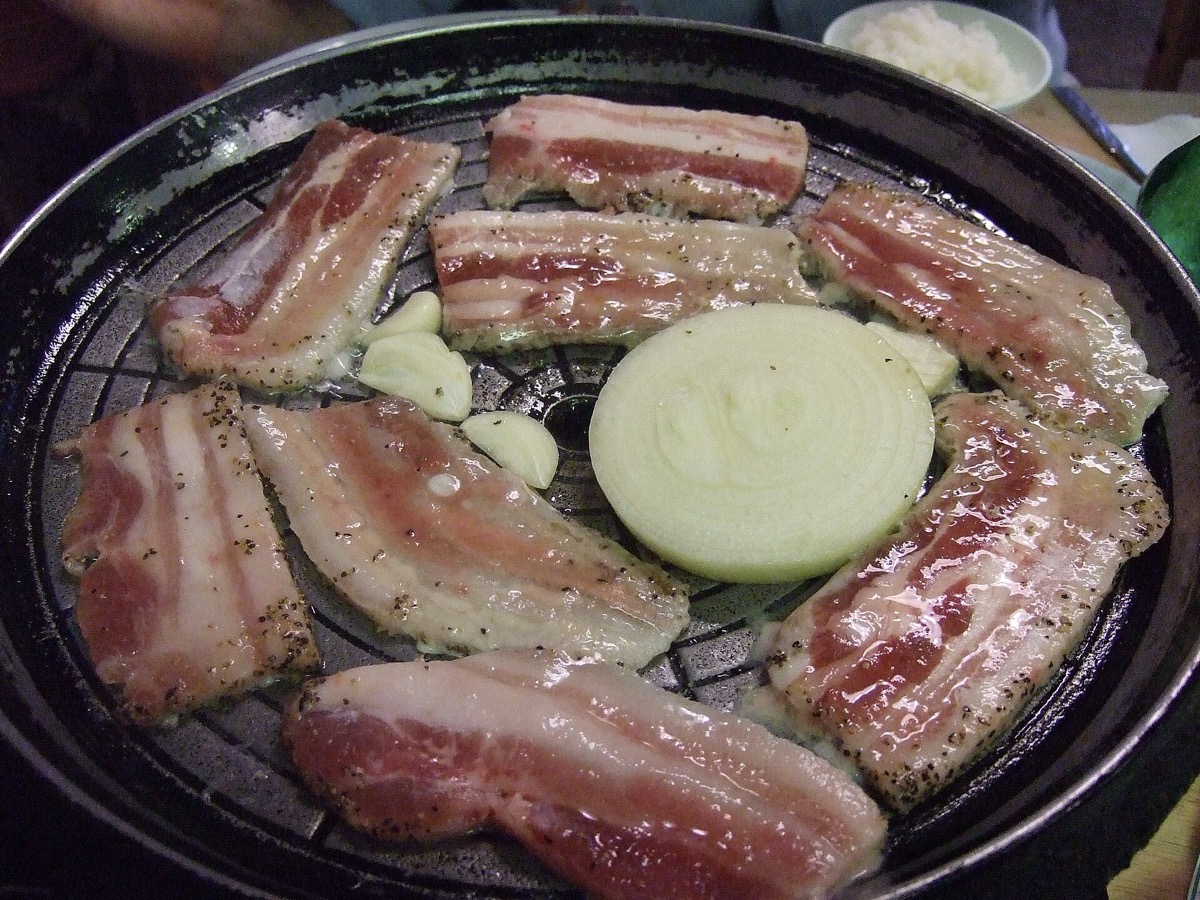
Samgyeopsal on the grill with garlic and onions — Wikimedia Commons photo

Food

Seoul Food Guide 2026: 5 Best Places for Samgyeopsal, Hanwoo, Samgyetang, Dak Hanmari & Gwangjang Market

5 Seoul restaurants picked by dish — samgyeopsal at Eongteori Saenggogi Hongdae, grilled hanwoo at Byeokje Galbi Bangi, samgyetang at Baengnyeon Tojong Samgyetang, dak hanmari at Dongdaemun Dak Hanmari Alley, and market food at Gwangjang Market. All 5 are listed on the official Korea Tourism Organization pages, and Byeokje Galbi and Baengnyeon Tojong Samgyetang also appear in the Michelin Guide. Each entry gives the signature dish, hours and a map link, plus the subway exit where an official source lists one.

The 3 routes for putting T-money on a phone and what each requires: Apple Wallet needs a Korean-issued card, the Mobile T-money app supports foreign-issued cards, Samsung Wallet uses the phone's USIM

Travel Tips

How to Add T-money to an iPhone in 2026 — Charging with Foreign Cards for Tourists, Apple Pay Transit Card Requirements, and Android Samsung Wallet

There are 2 routes for getting T-money onto an iPhone. If you create it directly in Apple Wallet, you need a credit or check card issued in Korea; if you create it through the Mobile T-money (모바일티머니) app, you can charge it with foreign-issued Mastercard, American Express, UnionPay, or JCB — Apple Pay handles it right inside the app. Visa is not on the app's charging list. On Android, the Samsung Wallet transit card charges onto the phone's USIM. This guide covers the registration steps, a comparison table of charging methods, what happens when the phone dies, how to buy a card at Incheon International Airport and Gimpo Airport, and what to do if you only have Visa.

Diagram of limits by charging method: cash 1,000–90,000 won, bank transfer 1,000–90,000 won, debit·credit card 10,000–50,000 won, maximum card balance 500,000 won

Travel Tips

T-money Card: Charging Limits, Refund Fee, and the 30-Minute Transfer Rule

Cash charging runs from ₩1,000 to ₩90,000 per transaction, and a single card can hold up to ₩500,000. The only places that take debit or credit cards are Woori Bank ATMs and GS25; everywhere else takes cash. You can get the remaining balance back at convenience stores, minus a ₩500 fee, but the card purchase price itself is not refunded. The transfer discount applies only if you board the next vehicle within 30 minutes of getting off.

Illustration of a Seongsu-dong street lined with converted red-brick factory buildings

Food

4 Celebrity-Approved Restaurants in Seongsu-dong — Visited by Sung Si-kyung, Pak Se-ri, Kim Na-young, and Choiza

Here are four Seongsu-dong restaurants featured on screen: the house-made sausage spot from Sung Si-kyung’s Eat What You Want, the buckwheat soba restaurant visited by Pak Se-ri, Kim Na-young’s regular buckwheat noodle spot, and the medicinal-herb chicken soup restaurant from Choiza Road. We read 150 visitor reviews to find out what to order, how to book, and what it costs.

Illustration of a sloping stone alley between walls, with layered hanok tiled roofs in Bukchon

Travel Tips

Bukchon Hanok Village: the 10am–5pm rule and the 100,000 won fine

Bukchon is a residential neighbourhood, not an attraction. Since March 2025 the alleys around Bukchon-ro 11-gil may only be visited between 10:00 and 17:00, and taking a photograph outside those hours carries a 100,000 won fine that applies to foreign visitors exactly as it does to Koreans. Here is which streets are covered, what counts as a violation, and where to walk instead.

Illustration of a passport, a work permit card and a calendar seen from above

Working in Korea

The E-9 Visa: What It Permits, How Long You Can Stay, and When You May Change Employer

Non-professional employment (비전문취업) E-9 is defined by exclusion — item 21 of attached Table 1-2 to the Enforcement Decree of the Immigration Act (출입국관리법 시행령 [별표 1의2]) covers anyone meeting the domestic employment requirements under the Act on the Employment of Foreign Workers (외국인근로자의 고용 등에 관한 법률), except those going into professional occupations. Employment activity runs 3 years from entry, extendable only once by less than 2 years — administered as 1 year 10 months, making 4 years 10 months — and one re-entry under the committed-worker re-entry special provision (성실근로자 재입국 취업 특례) takes the ceiling to 9 years 8 months. Changing workplace needs immigration's permission on statutory grounds, with an application required within 1 month of the contract ending and permission required within 3 months of filing. There is no dependent visa.

Illustration of an empty examination-room desk and answer sheet

Working in Korea

EPS-TOPIK Passing Scores and Selection — Why You Can Fail Even with More Than 60 Points

EPS-TOPIK is a Korean-language test administered by HRD Korea (한국산업인력공단) since August 2005 to rank candidates for the foreign jobseeker roster (외국인구직자 명부). It is different from the TOPIK administered by the National Institute for International Education (국립국제교육원), and it does not award proficiency levels. The exam has 40 questions worth 100 points and lasts 50 minutes, using CBT or UBT. The minimum scores are 60 for manufacturing, 45 for other sectors, and 30 Pass/Fail for the special fisheries track (어업특례). But clearing the minimum does not mean you have passed. The assessment is norm-referenced, and you must also take the second-stage skills test and job-capacity assessment (기능시험 및 직무능력평가).

Route diagram of the AREX Express from Seoul Station to Incheon Airport Terminal 1 and Terminal 2 with journey times and fare

Travel Tips

Incheon Airport to Seoul by AREX: Express vs All-Stop, Fares and Last Trains

AREX runs two trains between Incheon Airport and Seoul Station. The Express (직통열차) does it in 43 minutes from Terminal 1 for ₩13,000, and you must buy a separate ticket — tapping a transit card will not work on it. The all-stop train (일반열차) takes 59 minutes for ₩4,750 and does take a transit card. There is no foreigner discount on the Express, whatever you have read. All figures are as of August 2026.

Diagram showing how 209 monthly hours are built from 40 contracted hours plus 8 paid weekly-holiday hours

Working in Korea

Korea's 2026 Minimum Wage: ₩10,320 an Hour, ₩2,156,880 a Month

The minimum wage in Korea is ₩10,320 an hour from 1 January to 31 December 2026. The government's own monthly equivalent is ₩2,156,880 — gross, before deductions, built on 209 hours. It applies to every workplace with no exemption for industry or size, and to an E-9 worker on the same terms as anyone else. Below: where 209 comes from, what legally comes off your pay, and what your payslip has to show you.

Diagram comparing departure guarantee insurance at 8.3% of the monthly ordinary wage on the Employment Permit with statutory severance of 30 days' average wage per year, and the employer's duty to pay the difference

Working in Korea

Insurance for E-9 Workers: Who Pays What, and Why Departure Guarantee Insurance Is Not Your Severance

Industrial-accident insurance is funded entirely by the employer, so a line for it in your deductions is unlawful. Employment insurance has been mandatory for E-9 workers since the phase-in completed, and still deducts nothing unless you have opted into unemployment benefit at 0.9%. The National Pension is deducted for workers from the Philippines, China, Vietnam and Indonesia among others, and not at all for workers from Nepal, Myanmar, Bangladesh, Pakistan and Timor-Leste — but the E-9 visa is itself a qualifying route for the lump-sum refund, so nationality decides enrolment, not the refund. And departure guarantee insurance, at 8.3% of the ordinary wage on your Employment Permit, is a floor under your severance rather than the whole of it: where the lump sum falls short, the employer owes the difference.

Diagram of the official MOEL severance formula: daily average wage x 30 days x (days employed / 365)

Working in Korea

Severance Pay in Korea (퇴직금): How Much You Get and When It Must Be Paid

Work one year or more at the same workplace in Korea, with scheduled hours averaging 15 or more a week, and you are owed statutory severance pay: at least 30 days' average wage for every year of continuous service. The worked example below puts the 2026 monthly minimum wage of ₩2,156,880 through the Ministry of Employment and Labor formula and returns a figure near ₩2.1 million for one year. Nationality is not one of the conditions. The money is due within 14 days of your retirement date, and you have three years to claim it.